Emerald Ash Borer in New Hampshire: How to Identify an Infested Ash Tree
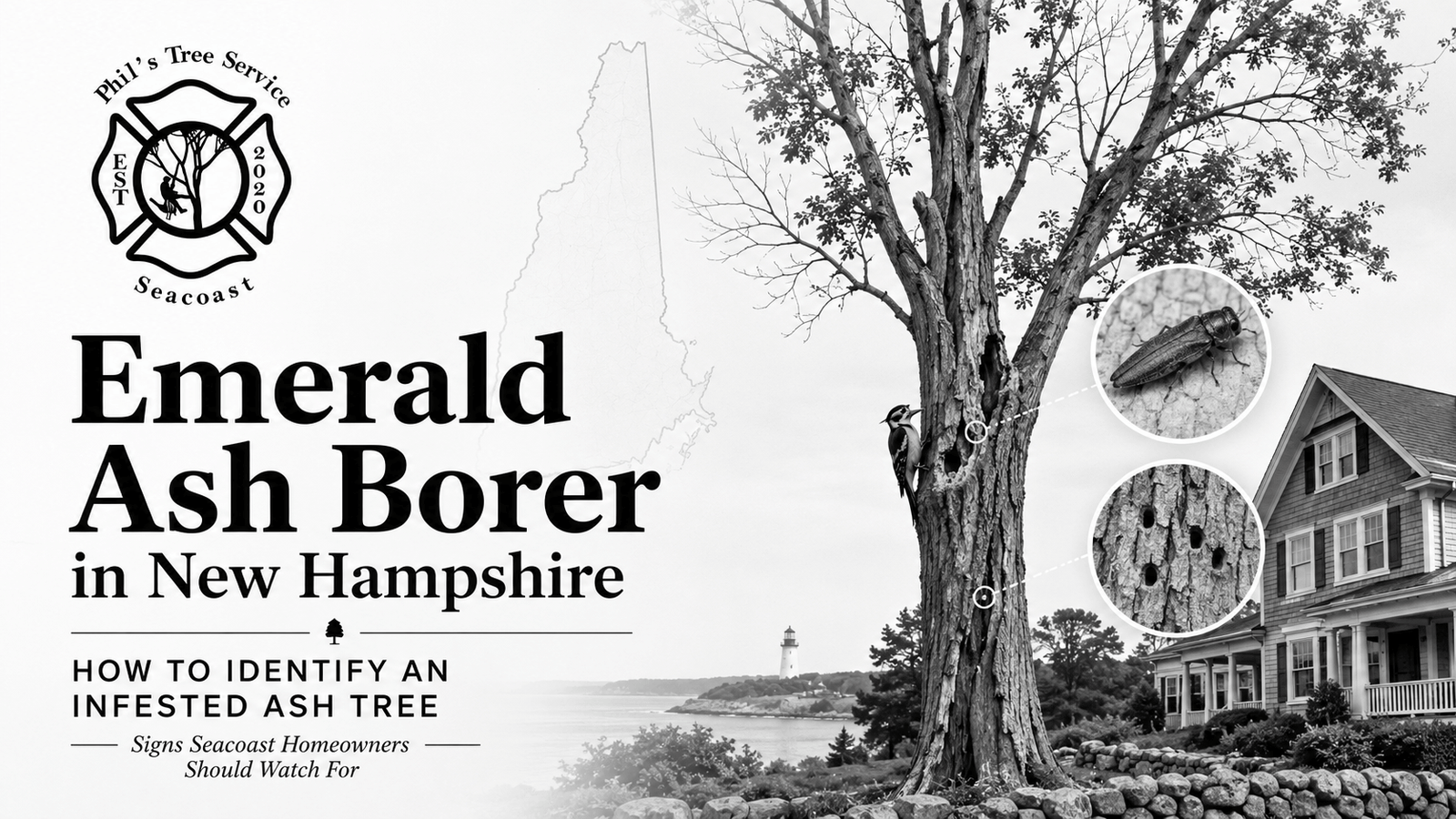
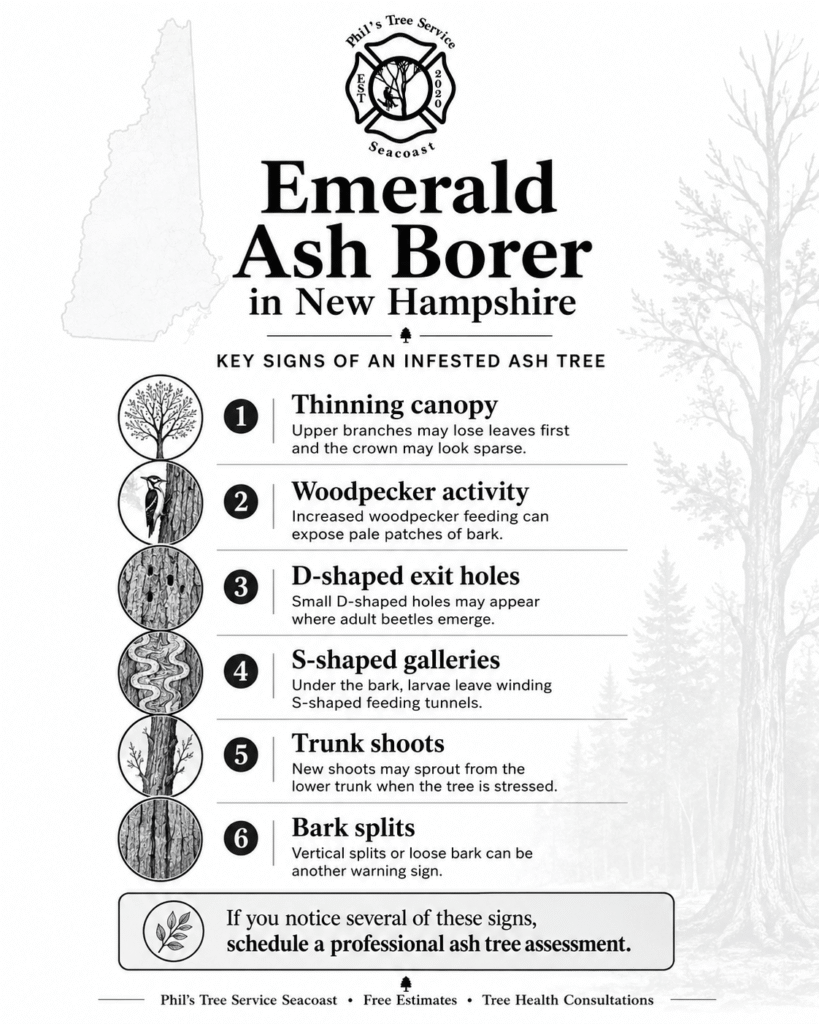
Emerald ash borer is present across much of New Hampshire, including numerous Seacoast communities. Homeowners with ash trees should look for thinning upper branches, peeling or light-coloured bark caused by woodpeckers, new shoots growing from the trunk, bark splits, D-shaped exit holes and S-shaped galleries beneath the bark.
Early evaluation matters. A healthy, high-value ash may sometimes be protected through professional treatment, while a heavily declining or structurally unsafe tree may need removal.
Is Emerald Ash Borer Present on the NH Seacoast?
Yes. New Hampshire’s official infestation list, updated September 24, 2025, includes Lee, Durham, Dover, Barrington, Epping, Exeter, Hampton, Madbury, Newfields, Newmarket, Northwood, Nottingham, Portsmouth, Raymond, Rochester, Rye and other nearby communities.
Finding emerald ash borer in a town does not mean every ash tree is already infested. It does mean property owners should identify and monitor ash trees rather than waiting for severe decline.
Emerald ash borer was first detected in New Hampshire in 2013. UNH Extension reports that an infested ash tree commonly dies within approximately three to five years, although the rate of decline can vary. The insect attacks ash trees rather than maples, oaks, birches, pines or other unrelated species.
How Do You Know Whether a Tree Is an Ash?
Confirm the species before assuming emerald ash borer is responsible.
Ash trees typically have:
- Branches and buds arranged opposite one another
- Compound leaves with multiple leaflets
- Diamond-shaped ridges on the bark of mature trees
- Paddle-shaped seeds that may hang in clusters
Young bark can look different from mature bark, and several other species may be mistaken for ash. A professional tree evaluation can confirm the species and distinguish pest damage from drought, root injury, soil compaction or another disease.
What Are the Main Signs of Emerald Ash Borer?
Thinning or dead upper branches
Canopy decline often begins near the top of an infested ash. Leaves may become sparse, individual limbs may die and the crown may look increasingly open.
Woodpecker blonding
Woodpeckers feed on emerald ash borer larvae beneath the bark. As they remove the dark outer bark, pale patches become visible. UNH Extension describes this lightened appearance as “blonding” and identifies it as an important sign to investigate.
D-shaped exit holes
Adult beetles leave small D-shaped holes when they emerge from the tree. These holes can be difficult to see, especially when they are high in the canopy.
S-shaped galleries
Larvae feed beneath the bark and create winding or S-shaped channels through the tree’s living tissue. USDA APHIS identifies these galleries, D-shaped holes, branch dieback, bark cracks and excessive trunk shoots as common infestation indicators.
New shoots on the trunk
An ash tree under serious stress may produce clusters of new shoots from the trunk or lower branches. These are sometimes called epicormic shoots.
Splitting or loose bark
As larvae damage the tissue beneath the bark, vertical cracks or loose sections may develop.
Can an Ash Tree With Emerald Ash Borer Be Saved?
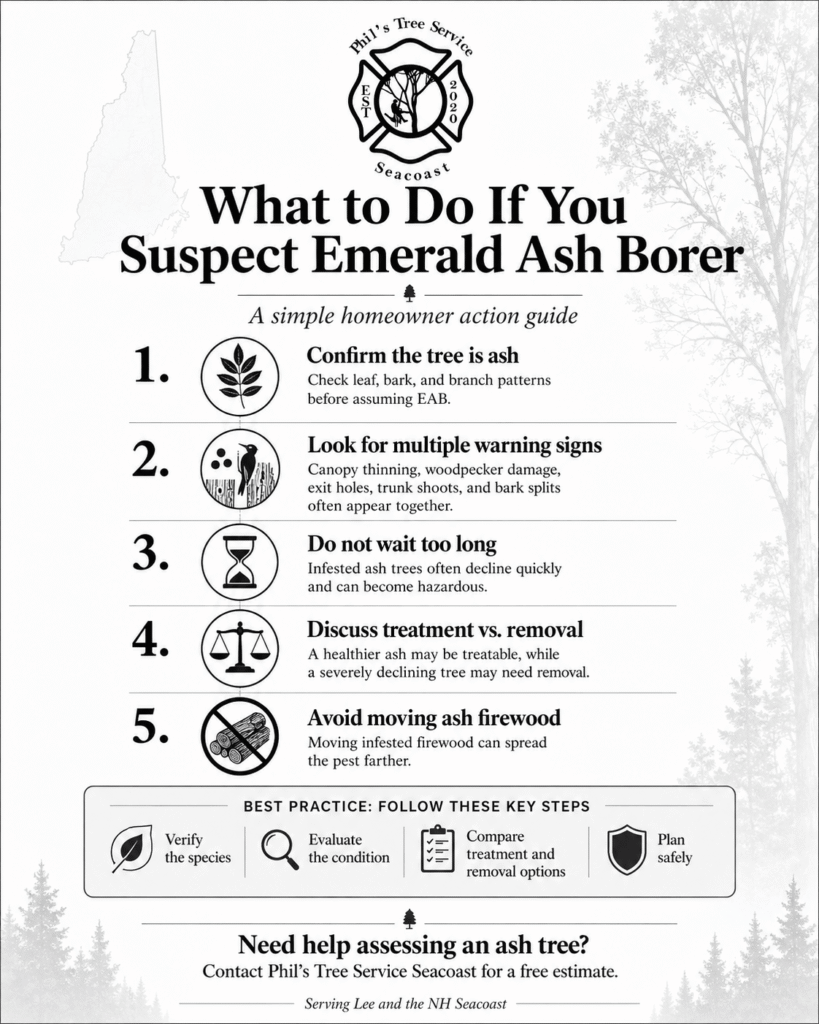
Some ash trees can be protected, but timing and tree condition are critical.
Treatment may be considered when the ash is:
- Structurally sound
- Important to the landscape
- Providing valuable shade
- In good overall condition
- Showing limited canopy decline
- Located where removal would be especially complex
UNH guidance indicates that at least half of the crown should generally remain alive for treatment to work effectively, with a fuller and healthier canopy offering a better outlook. Most effective treatment options should be evaluated and applied by an appropriately licensed professional.
Treatment is not automatically the right choice for every ash. It normally requires continued applications, and a tree that is already severely declining may be too damaged to recover.
When Should an Infested Ash Tree Be Removed?
Removal may be appropriate when the tree has:
- Extensive canopy death
- Major structural defects
- Severe bark loss
- Large dead limbs
- A compromised trunk
- A location beside a home, road, driveway or play area
- Declined beyond the point where treatment is practical
Dead and dying ash trees can become brittle. This can make later removal more complicated, particularly when the tree stands near buildings, fences, utility lines or neighbouring property.
A tree evaluation allows the homeowner to plan removal before the tree becomes an emergency.
Do Not Move Suspected Infested Firewood Long Distances
People can transport invasive insects much farther and faster than the insects travel naturally. New Hampshire encourages residents to buy firewood locally and burn it where they obtain it.
Do not transport suspected infested ash material without understanding current handling recommendations. Discuss chipping, log disposal and firewood options with the tree company before work begins.
Schedule an Ash Tree Evaluation
Emerald ash borer has already been documented throughout many NH Seacoast communities. Monitoring ash trees now gives homeowners more time to compare treatment, pruning and removal options.
Phil’s Tree Service Seacoast provides professional tree health consultations, removal, crane-assisted removal, brush chipping and log disposal throughout Lee and the surrounding Seacoast.
Contact the team for a free assessment if your ash tree has thinning branches, woodpecker blonding, bark splits, trunk shoots or other signs of decline.
Frequently Asked Questions
Does emerald ash borer attack every type of tree?
No. Emerald ash borer attacks ash trees in the Fraxinus genus. Similar symptoms on another species may have a different cause.
How fast does emerald ash borer kill an ash tree?
UNH Extension states that an infested ash commonly dies within about three to five years, although individual trees may decline at different rates.
Can I treat an ash tree myself?
Some products may be available to homeowners, but effective treatment depends on tree size, health, product selection, timing and application method. Certain treatments require a licensed applicator.
Should every ash tree be removed?
No. Healthy, valuable ash trees may sometimes be protected. Severely declining, structurally unsafe or poorly located trees may be better candidates for removal.